
Private Label
Perfume Production Line: Inside the 8 Stations + Throughput Math for Modern Filling Operations
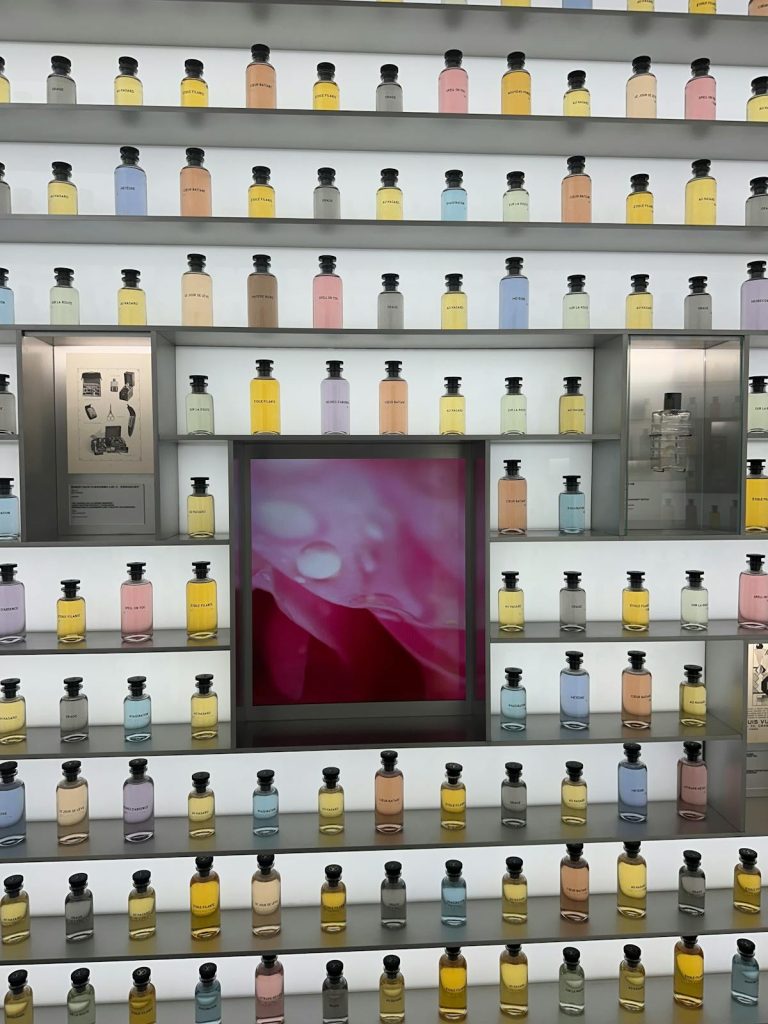
A modern perfume production line moves 800 to 4,000 bottles per hour through eight specialized stations — and the difference between brands that scale and brands that fail often comes down to understanding what happens at each station. The throughput, defect rate, automation level, and quality control discipline at every step determine your unit cost economics, your defect rate, and ultimately your reorder cycle. This guide takes you inside a real perfume production line: the 8 stations explained, throughput math by automation tier, defect rates per station, and the operational decisions that determine whether your manufacturer can meet your launch deadlines or destroy them.
💼 Get pricing in 24h via WhatsApp
WhatsApp us at +33617747713 with your monthly volume forecast and quality requirements. We respond within 24h with production line capability assessment.
👉 Get a production assessment on WhatsApp
Why the Production Line Matters for Brand Owners
Most brand owners never think about the production line beyond “the place where my bottles get filled.” This is a costly oversight. The production line determines four critical variables that directly affect your launch:
- Lead time — automated lines run 4,000 bottles/hour, manual lines run 200/hour. Same Pack 1,000 order: 15 minutes vs 5 hours of production time.
- Defect rate — automated lines achieve 0.5-1.5% defect rates. Manual lines run 3-8% defect rates. Defects cost you in returns, customer complaints, and reorder timing.
- Quality consistency — automated lines deliver bottle-to-bottle consistency in fill volume (±0.3ml), label placement (±0.5mm), and cap torque. Manual lines vary 5-15% on each metric.
- Production capacity — when your brand reaches Pack 5,000 monthly volume, your manufacturer must have capacity. Manual-line operations max out around Pack 8,000/month before quality degrades.
Choosing your manufacturer based on price-per-unit alone, without understanding their production line capabilities, is the #1 reason emerging brands hit operational walls in months 6-12 of launch.
The 8 Stations of a Modern Perfume Production Line
Station 1 — Bulk fragrance preparation (5-15 minutes)
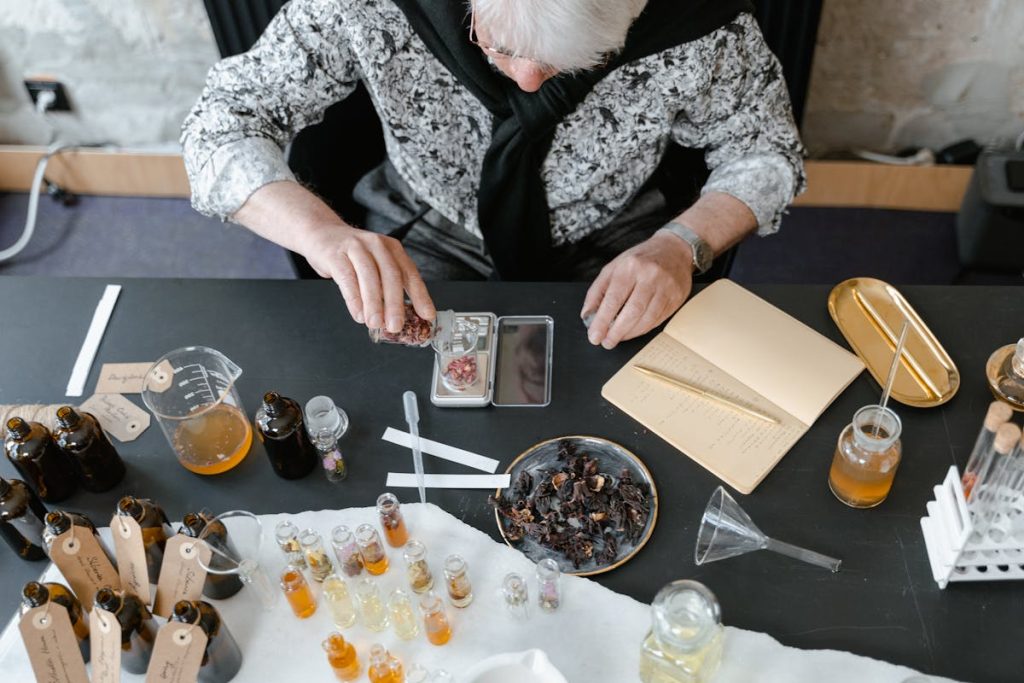
Concentrated fragrance compound is blended with denatured alcohol or oil carrier in stainless steel mixing tanks. Tank capacities range from 50L (small batch) to 5,000L (industrial). Mixing time depends on formula complexity — simple compositions blend in 10 minutes, complex multi-accord formulations may require 24-72 hours of maceration. Quality control: pH measurement, density verification, scent panel approval before proceeding.
Station 2 — Filtration and clarification (2-8 hours)
The blended fragrance passes through 1-5 micron filters to remove particulates, undissolved aroma chemicals, and any contamination. Premium production includes a “freeze filtration” stage where fragrance is chilled to -10°C, causing precipitates to form and be filtered out. Result: visually crystal-clear fragrance that doesn’t develop “haze” months after bottling.
Station 3 — Bottle preparation (variable)
Empty bottles arrive at the filling line. Three preparation steps: (1) inversion and air-blow to remove glass dust from manufacturing, (2) UV sterilization or alcohol rinse for hygiene compliance, (3) optical inspection for cracks, surface defects, or cap-fit issues. Reject rate at this station: 0.3-1.5% of bottles arrive with manufacturing defects.
Station 4 — Filling (the throughput station)
Heart of the production line. Five filling technologies, each with different throughput:
- Manual single-bottle filling: 150-250 bottles/hour. Used for ultra-premium and Pack 100 production.
- Semi-automatic fill: 800-1,500 bottles/hour. Operator places bottle, machine fills, operator removes.
- Automatic linear fill: 1,500-3,000 bottles/hour. Conveyor belt continuous flow.
- Rotary monobloc: 3,000-6,000 bottles/hour. Rotating turret simultaneously filling 8-16 bottles. Used at industrial scale.
- High-speed servo: 6,000-12,000 bottles/hour. Top-tier industrial. €450,000-€1.2M equipment investment.
Fill volume tolerance: ±0.3ml on automated, ±0.8ml on manual. For 50ml bottle, that’s 0.6% vs 1.6% variance — meaningful for cost and customer perception.
Station 5 — Capping and crimping (high-throughput)
Atomizer pump or screw cap applied to the bottle. Two technologies:
- Crimp capping: aluminum collar permanently crimps pump to bottle neck. Speed: 3,000-8,000 bottles/hour. Used for fixed pumps.
- Screw capping: torque-controlled screw application. Speed: 2,000-5,000 bottles/hour. Used for refillable bottles. Torque consistency ±0.2 Nm on automated lines.
Defect rate: 0.5-2% (loose cap, misaligned crimp, damaged thread). Quality control includes torque verification on random samples.
Station 6 — Labeling and decoration (medium throughput)
Labels applied via three technologies:
- Pressure-sensitive label (most common): pre-printed labels on backing paper, applied at 1,500-4,000 bottles/hour. ±0.5mm placement tolerance on automated.
- Direct-on-bottle silkscreen: ink screened directly to glass surface, baked at 180°C. Used for premium positioning. Speed: 800-2,000 bottles/hour.
- Hot-stamp foil: gold/silver foil pressed at high temperature. Used for accent decoration. Speed: 1,500-3,500 bottles/hour. Requires custom dies (€400-€1,800).
Station 7 — Packaging (variable)
Bottle inserted into outer box, plus any additional inserts (instruction cards, samples, ribbons). Three automation tiers:
- Manual hand-packing: 600-1,200 bottles/hour per operator. Used for ultra-premium where touch points matter.
- Semi-automatic with hand-finishing: 1,200-2,500 bottles/hour. Box assembly automated, ribbon and inserts hand-applied.
- Fully automatic cartoning: 3,000-6,000 bottles/hour. Box folded, bottle inserted, glued, all robotic.
Station 8 — Quality control and shipping prep (variable)
Final inspection station. Premium operations inspect 100% of units; mass-market inspects 1 in 50. Five quality checks: visual surface inspection, weight verification (catches underfilled bottles), label alignment, cap torque sample, packaging integrity. Pass rate: 97-99% on automated lines, 92-95% on manual lines.
💼 Need help evaluating manufacturer production capabilities?
WhatsApp us at +33617747713 with your monthly volume forecast and quality requirements. We respond within 24h with capability assessment.
Throughput Math by Automation Tier
| Production Tier | Bottles per Hour | Pack 1,000 Time | Pack 10,000 Time | Defect Rate |
|---|---|---|---|---|
| Manual / artisanal | 150-250 | 5-7 hours | 50-70 hours | 3-8% |
| Semi-automatic | 800-1,500 | 40-75 minutes | 7-12 hours | 1.5-4% |
| Automatic linear | 1,500-3,000 | 20-40 minutes | 3-7 hours | 0.8-2% |
| Rotary monobloc | 3,000-6,000 | 10-20 minutes | 2-3 hours | 0.5-1.5% |
| High-speed servo | 6,000-12,000 | 5-10 minutes | 1-2 hours | 0.3-1% |
The throughput difference compounds with quality difference. A high-speed servo line completes Pack 10,000 in 1-2 hours with 0.5% defect rate. A manual line takes 50-70 hours with 5% defect rate. For your launch, this means either a 3-day production timeline with 50 defective units, or a 9-day timeline with 500 defective units.
Defect Rates by Production Stage
Understanding where defects originate helps you spot quality issues before they reach your warehouse:
- Bottle preparation defects — 0.3-1.5% (cracked glass, surface defects). Catchable at incoming inspection.
- Filling defects — 0.2-1% (underfill, overfill, foreign particle in liquid). Catchable at fill-weight verification.
- Capping defects — 0.5-2% (loose cap, misaligned crimp, damaged thread). Catchable at torque verification.
- Labeling defects — 0.4-1.8% (misalignment, bubbles in label, smudged ink). Catchable at visual inspection.
- Packaging defects — 0.3-1.2% (creased box, torn ribbon, missing insert). Catchable at final QC.
Cumulative defect rate: 1.7-7.5% depending on automation tier. Premium production targets under 2%; mass-market accepts up to 5%.
How Production Line Capability Affects Your Brand
Three operational decisions flow from understanding your manufacturer’s production line:
1. Realistic lead time forecasting
If your manufacturer has only manual filling, Pack 5,000 takes 25-35 hours of production. With shifts and other clients in queue, this means 4-6 weeks. With automatic line, the same Pack 5,000 takes 2-3 hours, fitting into a single shift. Lead time for first order: 5-7 weeks vs 9-12 weeks.
2. Defect-rate-adjusted unit cost
Quoted unit cost €4.20 with 5% defect rate = effective unit cost €4.42 (you receive 950 usable units per Pack 1,000). Quoted €5.10 with 1% defect rate = effective unit cost €5.15. The “cheaper” supplier costs more after adjustment.
3. Scaling capacity
Brands hit operational walls when monthly volume exceeds manufacturer capacity. A manual-line operation can produce ~6,000-8,000 bottles/month max. If your Pack 1,000 monthly velocity grows to Pack 2,500, your manufacturer’s capacity is the bottleneck. Validate scaling capacity before signing first contract.
How to Evaluate a Manufacturer’s Production Line
Before signing production contracts, ask these specific questions:
- What automation tier is your filling line? (Manual / semi-auto / automatic / rotary / high-speed servo)
- What is your bottles-per-hour throughput on your fastest line?
- What is your monthly capacity ceiling at full utilization?
- What is the defect rate variance across the production line stations? On repeat runs?
- Can third-party QC inspectors access the production line during runs?
- Can I visit the factory during production of my order?
- What is your fill volume tolerance? Cap torque tolerance? Label placement tolerance?
- Do you have video documentation of your production line you can share?
Suppliers who hedge on these answers, refuse factory visits, or won’t share production videos are red flags. See our supplier vetting framework for the complete framework.
The Capital Investment Tiers Behind Production Lines
Understanding what your manufacturer invested in equipment helps you assess their stability:
- Manual line setup: €15,000-€50,000 total equipment. Easy to start, but capacity-limited and quality-variable.
- Semi-automatic line: €80,000-€250,000. Mid-tier capability, good for emerging brands.
- Automatic linear line: €350,000-€800,000. Established mid-market manufacturer.
- Rotary monobloc + automation: €1.2M-€3M. Industrial scale.
- High-speed servo with full automation: €4M-€12M. Top-tier industrial only.
Manufacturers with €350,000+ equipment investment have skin in the game — they can’t easily exit the business. Manufacturers running €30,000 manual setups can disappear overnight. Capital intensity is a stability signal.
How to Order Production: 8-Step Process
- Define product specifications — bottle, fragrance, label, packaging in measurable detail.
- Request manufacturer assessment — production line tier, capacity, defect history.
- Sample order ($30-$80) — verify scent quality, fill consistency, packaging integrity.
- Negotiate terms — pricing, MOQ, payment structure, defect tolerance, lead time guarantees.
- Pay deposit (30-50%) — production starts.
- Mid-production check — request photos or video at week 4-6 milestone.
- Pre-shipment QC ($150-$400) — third-party inspection before goods leave factory.
- Final payment, shipping, receipt inspection — document defects within 7 days for warranty claims.
6 Common Mistakes With Production Line Evaluation
- Mistake 1 — Ignoring production line tier when comparing prices. $4.20/unit on manual line = effective $4.50 with defects. $4.80/unit on automatic line = effective $4.85. The “cheaper” option costs more.
- Mistake 2 — Refusing to ask for factory visits. Legitimate manufacturers welcome visits. Refusal = red flag.
- Mistake 3 — Trusting “we can scale to any volume” claims. Capacity is finite. Verify with monthly bottles-per-hour math.
- Mistake 4 — Skipping defect rate questions. Defect rate affects effective unit cost more than quoted unit cost.
- Mistake 5 — Not asking about production capacity allocation. Your order shares production capacity with others. Confirm priority and timing.
- Mistake 6 — Ignoring fill tolerance specs. ±0.8ml fill on 50ml bottle = customer complaints about “underfilled” bottles.
Frequently Asked Questions
How fast can a perfume production line operate?
Manual lines: 150-250 bottles/hour. Semi-automatic: 800-1,500/hour. Automatic linear: 1,500-3,000/hour. Rotary monobloc: 3,000-6,000/hour. High-speed servo: up to 12,000/hour. Most emerging brands need only 1,500-3,000 bottle/hour capability.
What defect rate should I expect from a production line?
Premium automated production: 0.5-1.5% defect rate. Mid-market semi-automatic: 1.5-3%. Manual operations: 3-8%. Build defect reserve into your unit cost calculation.
Can I visit the factory before placing an order?
Yes — and you should. Legitimate manufacturers welcome factory visits. Refusal to allow visits is a red flag suggesting the operation isn’t what was claimed.
How long does a Pack 1,000 production run take on the line?
Pure production time: 5-7 hours on manual line, 40-75 minutes on semi-automatic, 20-40 minutes on automatic. Add bottle preparation, label setup, packaging, QC: total in-factory time 1-3 days. Plus 4-6 week lead time for fragrance preparation, ingredient sourcing, label printing.
What’s the difference between linear and rotary filling lines?
Linear: bottles move single-file on conveyor, single fill nozzle. Speed 1,500-3,000/hour. Rotary monobloc: bottles ride a rotating turret with 8-16 fill nozzles working simultaneously. Speed 3,000-6,000+/hour. Rotary requires 2-3× capital investment but delivers 2-4× throughput.
How do I verify production line claims?
Three methods: (1) request video tour of production line, (2) factory visit during your order’s production, (3) third-party audit reports (ISO 22716 GMP audits include production line inspection). See our supplier vetting framework.
The 4 Auxiliary Production Stages Most Brands Don’t Plan
Beyond the 8 main stations, four auxiliary stages affect production timeline and brand quality:
- Maceration period (2-12 weeks) — premium fragrances rest in stainless tanks 4-12 weeks after blending to allow molecular bonding. Cheap mass-market skips this; quality suffers measurably.
- Cold filtration cycle (12-72 hours) — fragrance chilled to -10°C to precipitate haze-causing compounds. Critical for visual clarity over 18+ month shelf life.
- Pre-production validation batch — 50-200 unit pilot run before main production. Catches scent profile drift, label alignment issues, packaging fit problems. Adds 1-2 weeks but prevents catastrophic full-batch defects.
- Aging-stability testing — accelerated aging tests (40°C for 90 days) verify formula stability. Required for international compliance.
How Production Line Quality Affects Long-Term Brand Health
Production line quality compounds over multiple ordering cycles. Three long-term effects:
- Customer return rate — 2% defect rate at production = ~4-6% customer complaints (defects compound with shipping damage). Premium production at 0.5% defect = 1-2% complaint rate.
- Scaling capacity ceiling — manual lines max around Pack 8,000/month. Brands that grow past this without manufacturer capacity match face 2-4 month delays during reorder.
- Reorder lead time consistency — automated lines deliver consistent 5-7 week lead times. Manual lines vary 6-14 weeks based on capacity utilization. Inconsistent lead times kill marketing campaign planning.
Where to Go Next
- Manufacturing process detail → Perfume Manufacturing Process
- Manufacturer comparison → Manufacturing Companies Comparison
- Private label tiers → Private Label Manufacturers
- Pillar guide → Private Label Perfume Pillar
- Supplier vetting → Supplier Vetting Framework
- Geographic options → Europe, China
👉 Get a production capability review on WhatsApp

